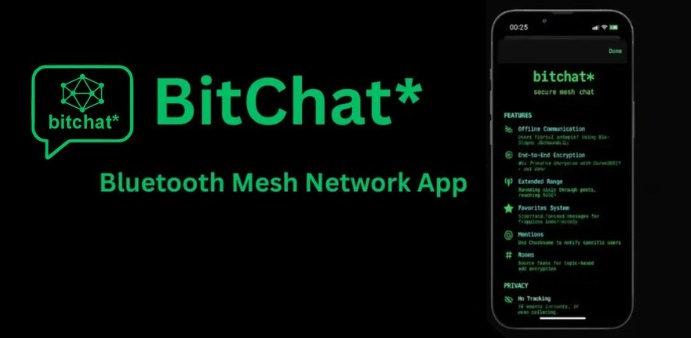
In an era where nearly every app assumes you’re constantly connected, Bitchat Mesh takes a radically different approach. Instead of relying on servers, data plans, or even Wi-Fi, it turns nearby iPhones into a small communication network of their own.
The idea is surprisingly simple: if the internet disappears, or simply becomes unreliable, you can still send messages.
It’s a reminder that communication doesn’t always need the cloud.
Messaging Without the Internet
At its core, Bitchat Mesh is a messaging app designed for Apple devices that works entirely over Bluetooth. The app creates what’s known as a mesh network, allowing nearby devices to pass messages between one another like digital relays.
Imagine sending a message to someone across a crowded concert venue. Even if they’re out of Bluetooth range, the message can travel through other nearby phones running the app, hopping from device to device until it reaches its destination.
No central servers. No login credentials. Just a chain of nearby devices quietly passing data along.
It sounds almost old-fashioned in today’s hyper-connected world, but that simplicity is precisely the point.
How the Network Forms
Launching the app immediately triggers a scan for other Bitchat users in the vicinity. When two devices detect one another, they establish a Bluetooth Low Energy connection and become part of a small, temporary network.
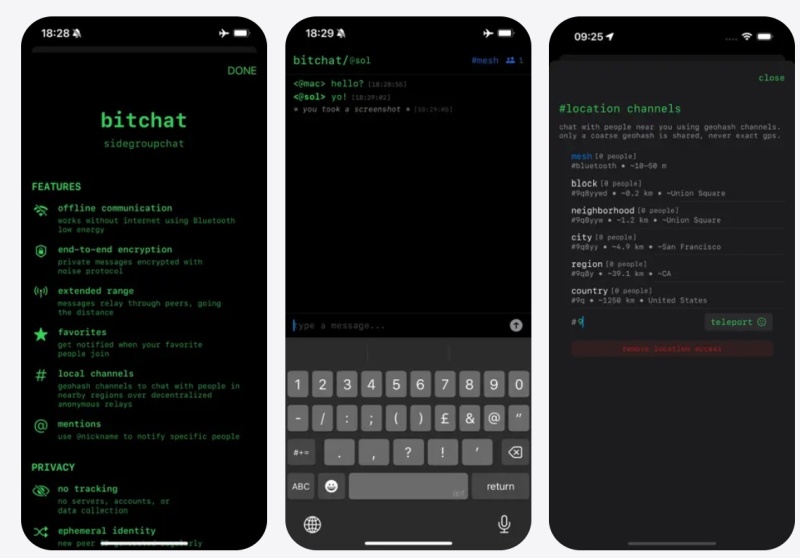
As more devices join, the network expands. Messages can move through multiple phones before arriving at the intended recipient. This kind of decentralized communication (often called peer-to-peer networking) means the system doesn’t depend on any external infrastructure.
The more people nearby using the app, the stronger the network becomes.
Messaging, Stripped Down
Bitchat Mesh isn’t trying to compete with feature-packed messaging platforms. Instead, it focuses on doing one thing extremely well: sending text messages in environments where traditional communication tools might fail.
Users can chat in two ways.
Public Chat functions as a shared message stream for everyone connected nearby. Think of it as a digital bulletin board floating through the mesh network.
Private Chat, on the other hand, allows two users to communicate directly through a unique identifier key.
There’s no emoji picker, no GIF search, and no media attachments. At least not yet. Messages are plain text, delivered quickly and quietly through Bluetooth.
Built With Privacy in Mind
One of the most unusual aspects of this application is what it doesn’t require.
There are no accounts to create, no phone numbers to verify, and no social logins. Open the app, choose a nickname, and you’re ready to go.
For privacy-conscious users, that absence of identity infrastructure is a major draw. The app collects no personal information and stores no centralized user database.
Messages themselves are protected with end-to-end encryption, meaning only the sender and recipient can read them. Even the devices relaying messages through the mesh network can’t see the contents.
The Panic Button
Bitchat Mesh also includes a feature that feels lifted from a spy thriller: Panic Mode.
With a single action, the app instantly wipes all stored messages and resets the interface. No history remains. No logs. No traces of previous activity.
If privacy is important to you, or you simply want full control over your data, this app has you covered.
Minimal by Design
If you open Bitchat Mesh for the first time, you’ll notice how little there is to configure. The interface is deliberately sparse.
A message field.
A send button.
A list of nearby connections.
There are no layered menus or crowded dashboards competing for attention. The experience feels closer to an early chat client than a modern social platform, and honestly, that’s part of its charm.
The app launches and begins working almost instantly.
Where It Actually Makes Sense
While a Bluetooth messenger may sound niche, there are plenty of situations where it becomes surprisingly practical.
Large events, for example, often overwhelm cellular networks. A packed stadium or music festival can leave thousands of phones struggling to maintain a signal.
In those environments, a local mesh network can sometimes succeed where cellular infrastructure fails.
The same applies in remote areas with limited connectivity or during emergencies when internet access becomes unavailable.
In those moments, even a simple text-only communication channel can be incredibly valuable.
The Mind Behind the Project
The project was created by Jack Dorsey, the co-founder of Twitter and CEO of Block.
Interestingly, Bitchat began as a a quick project meant to demonstrate how powerful decentralized communication can be when stripped down to its essentials.
That experimental spirit still shows in the app’s design.
Open Source From Day One
Bitchat Mesh is also fully open source and hosted on GitHub. Anyone can inspect the code, contribute improvements, or even build their own version.
For security-minded users, that transparency matters. Anyone can audit how the system works, not just a single company.
The Trade-Offs
Of course, the minimalist approach comes with a few limitations.
For now, the app supports text messages only. Photos, videos, and links are absent. Emoji lovers will also have to wait.
The app is also limited to Apple devices running iOS 15 or later, meaning Android users can’t join the network.
And because it depends on nearby devices, the system needs at least a few active users within Bluetooth range (roughly 100 meter) to function.
Still, those constraints are largely intentional. This chat software isn’t trying to replace mainstream messaging platforms. It’s exploring what communication might look like without them.
A Glimpse of What’s Next
Future updates may expand the concept. Developers have already discussed adding support for Wi-Fi Direct to increase range and integrating optional connections to decentralized protocols like Nostr.
If those features arrive, Bitchat could evolve from a local messaging tool into something far more ambitious.
The Bottom Line
Bitchat Mesh isn’t meant to compete with feature-heavy chat apps like iMessage or WhatsApp. Instead, it occupies a different category entirely: communication without infrastructure.
It’s simple, private, and surprisingly elegant in its restraint.
And in a world where nearly every digital conversation flows through centralized servers, that idea feels refreshingly different.
